Overview of Common Finger Injuries and Prevention
Updated: Mar 31
Danny Wolf, OTD Student
Introduction
Rock climbing places extraordinary demands on the fingers, requiring them to withstand forces far beyond what they were originally designed for. It should come as no surprise that finger injuries are the most common category of injury faced by climbers (Schöffl et al., 2003; Schöffl et al., 2015, Schöffl et al., 2020). Three of the most common finger injuries climbers experience include: annular pulley injuries, finger flexor tenosynovitis, and capsulitis.
This article provides an overview of these injuries, the anatomy involved, how they occur, and evidence-informed strategies for management and prevention.
Climbing Grips and Injury Risk

Not all climbing grips are created equal. The stress placed on the fingers varies significantly depending on grip type.
Open-handed grips—where the proximal interphalangeal (PIP) joint remains at an angle greater than 90 degrees—are generally less stressful and place climbers at lower risk of injury (Schweizer, 2008). In contrast, closed-handed grips increase stress, with the full crimp producing the most strain on the fingers and the structures within them.
Because grip choice directly influences stress to the tissue, it plays an important role in both injury development and prevention.
Relevant Anatomy
Finger flexion during climbing is primarily produced by two tendons:
Flexor Digitorum Superficialis (FDS): attaches to the middle phalanx
Flexor Digitorum Profundus (FDP): attaches to the distal phalanx
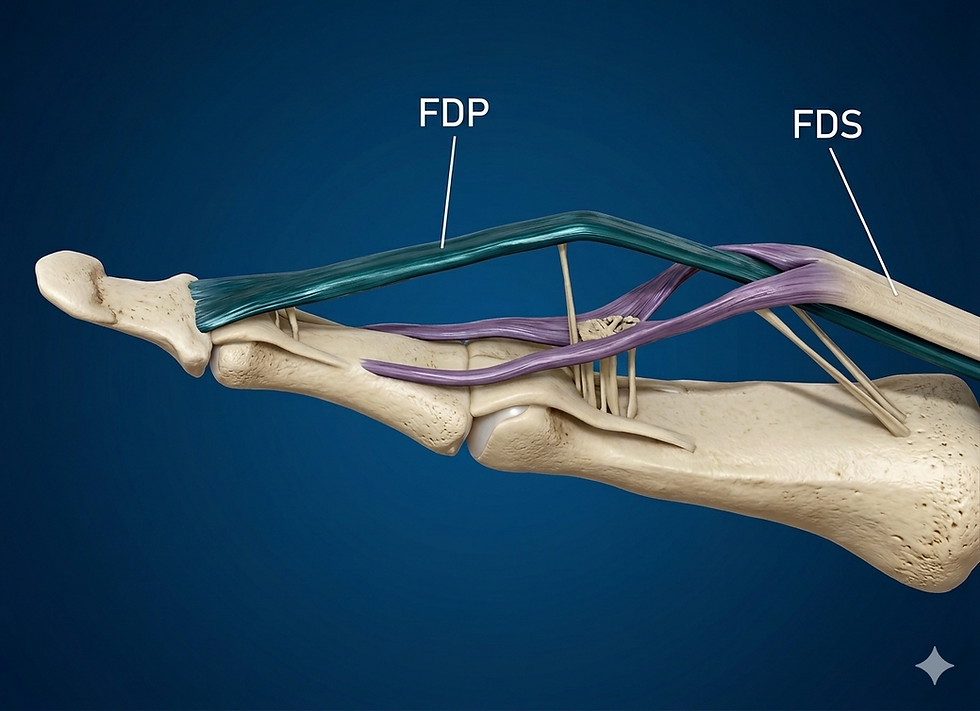
These tendons originate in the forearm and transmit force to the fingers, enabling climbers to support significant portions of their body weight.
Supporting these tendons are the annular pulleys, fibrous bands of tissue that hold the tendons close to the bone. Their function is similar to the eyelets on a fishing rod, which keep the line close to the rod. This positioning provides a mechanical advantage, allowing efficient force transfer. Without the pulleys, the tendons would “bowstring” away from the bone, reducing the efficient transmission of forces from the muscles into the fingers (Crowley, 2012).


Sourced from Lehner (2020)
The A2 and A4 pulleys are the most commonly injured, resulting from the high mechanical stress placed on them during climbing, and especially while crimping (Bosco, 2022).
Annular Pulley Injuries
Prevalence
Pulley injuries are the most common climbing-related injury, accounting for approximately 12.4–20.2% of all injuries. (Schöffl et al., 2003; Schöffl et al., 2015, Schöffl et al., 2020)
Mechanism of Injury
Pulley injuries can occur as a result of sudden shock loading of the tissue, such as a foot slip while crimping, or from repetitive stress to pulleys over time (Cockenpot et al., 2016; Schweizer, 2008). The full crimp grip is particularly problematic. Research has shown that, in comparison to the sloper grip, the full crimp grip can place:
4× more force on the A4 pulley (Vigoroux et al., 2006)
36× more force on the A2 pulley (Vigoroux et al., 2006)

Sourced from Miro et al. (2021)
One study found that the A2 pulley can withstand on average roughly 90 lbs of force (Lin et al., 1990). Another study found that climbers regularly load the A2 pulley with ~85 pounds of force (Schweizer, 2000). A ~154 pound climber can shock load the A2 pulley with ~100 pounds of force during certain dynamic movements (foot slips while crimping or dynamic moves to/from small holds) (Bollen, 1990).
Symptoms
Sudden sharp pain with a tearing sensation
Possible audible “pop”
Swelling, bruising, and tenderness
Difficulty bending the finger
Pain with resisted flexion
In severe cases: visible bowstringing
(Crowley, 2012; Dy & Daluiski, 2013; Freilich, 2015)
Why It Shouldn’t Be Ignored
Ignoring a pulley injury can lead to:
Worsening damage (e.g., partial tear → complete tear) (Schöffl et al., 2016)
Longer recovery times (Schöffl et al., 2016)
Flexion contractures (Schöffl et al., 2016)
Secondary complications such as tenosynovitis (Bouredoucen et al., 2026)
Prompt evaluation by a clinician (Physician, OT, PT) is recommended, but at the very least, you should adjust your climbing routine to reduce the stress to your pulleys (e.g. stick to easier routes with large holds, avoid routes with small holds that require crimping).
Management
Treatment depends on injury severity:
Grades 1–3: typically managed conservatively (Schöffl et al., 2016)
Rest or reduced climbing load
Avoidance of crimping
Range of motion exercises
Progressive loading and rehabilitation
Taping or splinting
Grade 4: may require surgical repair
Recovery timelines range from ~6 weeks (mild) to up to 6 months (severe) (Schöffl et al., 2016).

Sourced from (Schöffl et al., 2003)
Finger Flexor Tenosynovitis
Overview
Tenosynovitis is inflammation of the synovial sheath surrounding the tendon. Climbers often refer to this as “tendonitis,” though true tendonitis is less common (Schöffl et al., 2016).
Mechanism
Repetitive stress, especially from crimping and dynamic loading, affects not only the pulleys but also the tendon sheath (Lutter et al., 2020; Schöffl et al., 2016; Schöffl et al., 2020) This can lead to a cycle of:
Irritation
Inflammation
Increased fluid production
Further constriction and irritation
This process can become chronic if not addressed (Schöffl et al., 2016).
Why is crimping stressful to the tendon sheath?

Sourced from Schöffl et al. (2016).
The crimp grip creates sharper angles as the tendon passes through A2 and A4 pulleys. These sharp angles create increased stress to these areas of the tendon sheath, as well as the pulleys.
Symptoms
Pain near the A2 and A4 pulleys
Pain extending into the palm or forearm
Swelling and redness
Tenderness to pressure
Grinding or clicking sounds
Gradual or sudden onset
(Klauser et al., 1999; Lutter et al., 202; Miro et al., 2024; Schöffl & Schöffl, 2007; Schöffl et al., 2016; Schöffl et al., 2020)
Differentiation from Pulley Injury
Symptoms can be similar to those of a pulley injury. Imaging is the only way to confirm which injury it is but there may be some clues that can point you in the right direction:
Tenosynovitis: more commonly will have a gradual onset, pain may radiate into palm and forearm
Pulley injury: more commonly will have a sudden onset, localized pain
Why It Shouldn’t Be Ignored
If untreated, tenosynovitis can:
Become chronic
Turn into tendonitis
Severely limit hand function
(Schöffl et al., 2016)
Management
Treatment is largely conservative:
Rest and load reduction
NSAIDs
Ice
Brush massage
Compression wrapping
Finger strengthening exercises
(Mohn et al., 2021; Schöffl et al., 2016)
If symptoms persist beyond 6 weeks, corticosteroid injections may be considered (Schöffl et al., 2016).
Capsulitis

Sourced from Schöffl et al. (2025)
Overview
Many climbers appear to have enlarged joints and tissues in their fingers. This is not necessarily indicative of an injury. However, if you have enlarged joints and they are causing you pain or restricting your range of motion, you may have capsulitis. Capsulitis involves inflammation of the joint capsule, typically affecting the PIP or DIP joints in the fingers of climbers.
Mechanism
The mechanism of injury is not fully understood, however this is the leading theory: High joint pressures, especially from crimping, lead to inflammation and fluid buildup within the joint (Schöffl et al., 2025). This can create a cycle similar to tenosynovitis:
Overload
Inflammation
Fluid accumulation
Further irritation
Symptoms
Joint stiffness
Localized swelling
Persistent dull ache
Reduced range of motion
Difficulty flexing fingers fully
(Miro et al., 2024; Schöffl et al., 2016b)
Why It Shouldn’t Be Ignored
Untreated capsulitis can lead to:
Chronic inflammation
Osteoarthritis- a degenerative condition which causes permanent damage to the tissues within the joint
(Mathiessen & Conaghan, 2017; Scanzello & Goldring, 2012; Schöffl et al., 2025)
Management
Early stage (<6 weeks):
Conservative care (ice, exercise, movement therapy)
Persistent cases:
Corticosteroid injections
Advanced interventions in severe cases
Return-to-climbing timelines range from ~2 weeks (mild) to 10+ weeks (severe).
(Schöffl et al., 2025)

Sourced from Schöffl et al., (2025)
Taping: What Does the Evidence Say?
Limited evidence overall for taping following a finger injury
Best evidence for taping is in the management of pulley injuries, specifically using the H-taping method
No studies have found that taping is helpful for preventing finger injuries
(Schöffl et al., 2007)

This image helps explain why H-taping may help while recovering after a pulley injury. It helps reduce the angle of the tendon as it passes through the A2 and A4 pulleys, thereby reducing the stress on these structures as they heal.
Sourced from Schöffl et al. (2016)
Prevention Strategies
One of the most important and multi-faceted strategies to help prevent finger injuries is load management (Miro et al., 2021; Quarmby et al., 2023), which broadly means being aware of the activities that put stress on your fingers and trying to limit them.. Pay careful attention to how much you are exerting your fingers and hands on holds (Danion, 2008), especially because beginners often grab harder than necessary, increasing finger stress and accelerating fatigue. Another great way to reduce the overall strain on your fingers is by using proper climbing technique with good footwork (Danion, 2008; Gable, 2017). Most of the work should be done with your legs while maintaining tension throughout your entire body.
Proper rest is also very important (Schöffl et al., 2016). Your tissues need a chance to heal. Try to plan 1-2 days rest, especially after intense climbing days.
Warming up can help prepare your muscles and tissues for climbing. (Miro, et al., 2021; Schöffl et al., 2016; Schweizer, 2008). It doesn't have to be complicated. Just doing 4 easy top rope routes or 8-10 easy boulder routes will do the job.
Finger extensor training may also help with finger injury prevention (Vigoroux et al., 2015). Climbing strengthens the flexors in our finger so extremely, that it can create a muscle imbalance with your finger extensor muscles. Think about it similarly to your core and back muscles. If you have weak core muscles, your back has to do more work which puts you at increased risk of injury.
There are a few things that are high-risk to your fingers that you should limit as much as possible. These include limiting dynamic moves to and from small holds (Moor et al., 2009; Schneeberger & Schweizer, 2016; Schöffl et al., 2003) and limiting use of the full crimp grip (Roloff et al., 2006; Schöffl & Schöffl, 2006; Schöffl et al., 2009a, 2009b). This extreme-pressure grip should be reserved only for when absolutely necessary. Similarly, you should limit one and two-finger holds (Schöffl et al., 2016b), as they put an extreme amount of stress onto your fingers.
Something to always keep in mind is you should listen to your body (Gable, 2017; Schöffl et al., 2016b). If you are experiencing persistent pain in your fingers, or experience sudden sharp pain, don’t ignore it. See a clinician who is knowledgeable of climbing injuries if you are able. At the very least, adjust your climbing routine to avoid crimpy routes with small holds, sticking to easier routes with large holds.
References
Bollen, S. R. (1990). Injury to the A2 pulley in rock climbers. Journal of Hand Surgery, 15(2), 268–270. https://doi.org/10.1016/0266-7681(90)90135-q
Bosco, F., Giustra, F., Lusso, A., Faccenda, C., Artiaco, S., & Massè, A. (2022). Closed flexor pulley injuries: A literature review and current practice. Journal of Orthopaedics, 34, 246–249. https://doi.org/10.1016/j.jor.2022.09.002
Bouredoucen, H., Bouvet, C., Taihi, L., Laredo, J.-D., & Schöffl, V. (2026). The climber’s finger: Imaging of finger flexor tendon pulley injuries. European Journal of Radiology, 198, Article 112757. https://doi.org/10.1016/j.ejrad.2026.112757
Cockenpot, E., Lefebvre, G., Demondion, X., Chantelot, C., & Cotten, A. (2016). Imaging of sports-related hand and wrist injuries: Sports imaging series. Radiology, 279(3), 674–692. https://doi.org/10.1148/radiol.2016150995
Crowley, T. P. (2012). The flexor tendon pulley system and rock climbing. Journal of Hand and Microsurgery, 4(1), 25–29. https://doi.org/10.1007/s12593-012-0061-3
Danion, F. (2008). Grip force safety margin in rock climbers. International Journal of Sports Medicine, 29(2), 168–172. https://doi.org/10.1055/s-2007-965112
Dy, C. J., & Daluiski, A. (2013). Flexor pulley reconstruction. Hand Clinics, 29(2), 235–242. https://doi.org/10.1016/j.hcl.2013.02.005
Freilich, A. M. (2015). Evaluation and treatment of jersey finger and pulley injuries in athletes. Clinics in Sports Medicine, 34(1), 151–166. https://doi.org/10.1016/j.csm.2014.09.001
Gable, M. (2017). Beyond tape: The guide to climbing injury treatment and prevention. Self-published.
Lehner, S. (2020, August 22). [Man fishing at Bettmersee, Bettmeralp, Schweiz] [Photograph]. Unsplash. https://unsplash.com/photos/a-person-holding-a-fishing-rod-near-a-body-of-water-lGvoePYyNP0
Lutter, C., Tischer, T., & Schöffl, V. (2021). Olympic competition climbing: The beginning of a new era—a narrative review. British Journal of Sports Medicine, 55(15), 857–864. https://doi.org/10.1136/bjsports-2020-102035
Mathiessen, A., & Conaghan, P. G. (2017). Synovitis in osteoarthritis: Current understanding with therapeutic implications. Arthritis Research & Therapy, 19(18), 2–9. https://doi.org/10.1186/s13075-017-1293-2
Miro, P. H., vanSonnenberg, E., Sabb, D. M., & Schöffl, V. (2021). Finger flexor pulley injuries in rock climbers. Wilderness & Environmental Medicine, 32(2), 247–258. https://doi.org/10.1016/j.wem.2021.01.011
Mohn, S., Spörri, J., Mauler, F., Kabelitz, M., & Schweizer, A. (2022). Nonoperative treatment of finger flexor tenosynovitis in sport climbers—A retrospective descriptive study based on a clinical 10-year database. Biology, 11(6), 815. https://doi.org/10.3390/biology11060815
Moor, B. K., Nagy, L., Snedeker, J. G., & Schweizer, A. (2009). Friction between finger flexor tendons and the pulley system in the crimp grip position. Clinical Biomechanics, 24(1), 20–25. https://doi.org/10.1016/j.clinbiomech.2008.10.002
Quarmby, A., Zhang, M., Geisler, M., Javorsky, T., Mugele, H., Cassel, M., & Lawley, J. (2023). Risk factors and injury prevention strategies for overuse injuries in adult climbers: A systematic review. Frontiers in Sports and Active Living, 5. https://doi.org/10.3389/fspor.2023.1269870
Roloff, I., Schöffl, V. R., Vigouroux, L., & Quaine, F. (2006). Biomechanical model for the determination of the forces acting on the finger pulley system. Journal of Biomechanics, 39(5), 915–923. https://doi.org/10.1016/j.jbiomech.2005.01.028
Scanzello, C. R., & Goldring, S. R. (2012). The role of synovitis in osteoarthritis pathogenesis. Bone, 51(2), 249–257. https://doi.org/10.1016/j.bone.2012.02.012
Schneeberger, M., & Schweizer, A. (2016). Pulley ruptures in rock climbers: Outcome of conservative treatment with the pulley-protection splint—A series of 47 cases. Wilderness & Environmental Medicine, 27(2), 211–218. https://doi.org/10.1016/j.wem.2015.12.017
Schöffl, V., Hochholzer, T., Winkelmann, H. P., & Strecker, W. (2003). Pulley injuries in rock climbers. Wilderness & Environmental Medicine, 14(2), 94–100. https://doi.org/10.1580/1080-6032(2003)014[0094:PIIRC]2.0.CO;2
Schöffl V, Schöffl I. Injuries to the Finger Flexor Pulley System in Rock Climbers - Current Concepts. J Hand Surg [Am]. 2006;31(4):647-54.
Schöffl, I., Oppelt, K., Jungert, J., Schweizer, A., Neuhuber, W., & Schöffl, V. (2009a). The influence of the crimp and slope grip position on the finger pulley system. Journal of Biomechanics, 42(13), 2183–2187. https://doi.org/10.1016/j.jbiomech.2009.06.005
Schöffl, I., Oppelt, K., Jungert, J., Schweizer, A., Bayer, T., Neuhuber, W., & Schöffl, V. (2009b). The influence of concentric and eccentric loading on the finger pulley system. Journal of Biomechanics, 42(13), 2124–2128. https://doi.org/10.1016/j.jbiomech.2009.05.035
Schöffl, V., Popp, D., Küpper, T., & Schöffl, I. (2015). Injury trends in rock climbers: Evaluation of a case series of 911 injuries between 2009 and 2012. Wilderness & Environmental Medicine, 26(1), 62–67. https://doi.org/10.1016/j.wem.2014.08.013
Schöffl, V., Hochholzer, T., & Lightner, S. (2016). One move too many. Sharp End Publishing.
Schöffl, V., Schöffl, I., Frank, L., et al. (2020). Tendon injuries in the hands in rock climbers: Epidemiology, anatomy, biomechanics and treatment—an update. Muscles, Ligaments and Tendons Journal, 10(2), 233–243. https://doi.org/10.32098/mltj.02.2020.08
Schöffl, V. R., Lutter, C., Lang, H.-C., Perl, M., Moser, O., & Simon, M. (2025). Efficacy of a new treatment algorithm for capsulitis of the fingers in rock climbers. Frontiers in Sports and Active Living, 7. https://doi.org/10.3389/fspor.2025.1497110
Schweizer, A. (2000). Biomechanical effectiveness of taping the A2 pulley in rock climbers. Journal of Hand Surgery (British and European Volume), 25(1), 102–107. https://doi.org/10.1054/jhsb.1999.0335
Schweizer, A. (2008). Biomechanics of the interaction of finger flexor tendons and pulleys in rock climbing. Sports Technology, 1(6), 249–256. https://doi.org/10.1002/jst.68
Vigouroux, L., Goislard de Monsabert, B., & Berton, E. (2015). Estimation of hand and wrist muscle capacities in rock climbers. European Journal of Applied Physiology, 115(5), 947–957. https://doi.org/10.1007/s00421-014-3076-6

Comments